During September and October 2026, I participated in four events that brought together different parts of the space economy: the European Rover Challenge in Kraków, the ESA Investor Forum in Paris, the International Astronautical Congress in Antalya, and CEE Space & Defense Day in Balatonfüred. Across these meetings, my focus remained the same: strengthening the Central and Eastern European space ecosystem and creating practical opportunities for its universities, companies and entrepreneurs.
For me, ecosystem development means connecting capabilities with the people and institutions that can help them grow. Research needs industrial partners and routes to application. Entrepreneurs need access to customers, capital and international networks. Universities need partnerships that translate knowledge into relevant education and new opportunities for students. These four events provided complementary settings in which to work on those connections.
The European Rover Challenge, held on 4–6 September in Kraków, demonstrated how space robotics can bring education, engineering and industry together. Its combination of an international competition, a space industry conference and public engagement creates opportunities for students to test their capabilities and engage with the wider sector. For CEE, this is particularly valuable: developing a space economy starts with building skills and giving emerging talent opportunities to apply them.
The event also offered a setting for strengthening regional academic relationships. Exchanges with AGH University of Krakow’s Faculty of Space Technologies and the UNIVERSEH European Space University alliance explored opportunities for further cooperation. Such relationships can help connect education, research and industry across national borders and give regional initiatives a broader international foundation.
The ESA Investor Forum, held on 18 September at ESA Headquarters in Paris, addressed another essential part of ecosystem development: financing growth. Organised by ESA with support from the European Commission and EUSPA, it brought together institutional and private investors, financing specialists and representatives of Europe’s space institutions. Discussions covered public-private partnerships, the role of public demand in developing commercial markets, and financing opportunities across different space activities.
For emerging CEE space companies, access to these conversations matters. Technical capability must be supported by credible business models, customer relationships and suitable financing. My participation formed part of a wider effort to connect regional opportunities with European investment networks and better understand how public institutions and private capital can support commercial development.
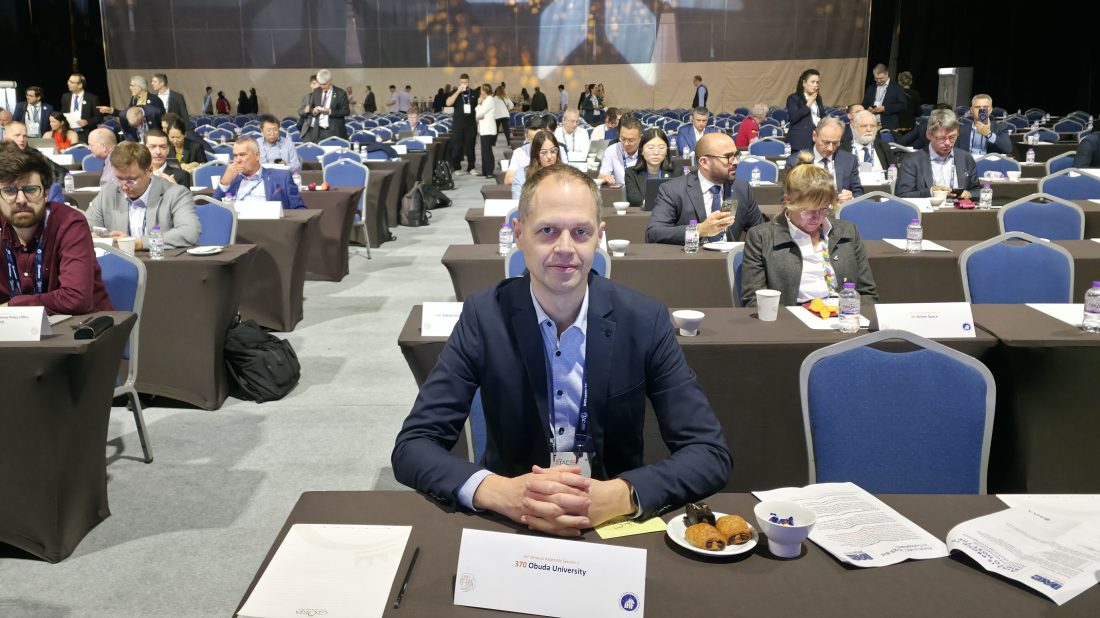
At the International Astronautical Congress, held on 5–9 October in Antalya, this work continued through scientific contributions, institutional engagement and partnership discussions. IAC provides a setting where research, industry, education and space policy meet, making it an important place to bring CEE capabilities into international discussions.
Our team contributed three papers. “The (New Space) Economics Behind CubeSats V2: Connecting Emerging CEE Space Ecosystems Through Economic Performance and Sustainability” examined CubeSat missions from an economic and sustainability perspective. This work contributes to understanding how smaller missions can support the development of emerging ecosystems and how their value can be assessed beyond the technology itself. The research was also recommended for submission to the Inaugural Space Economy Conference in March 2027.
A second interactive presentation, “Requirement and Design of an Intelligent Personal Protective System (PPS) – A Safe Space Garment Software Architecture”, addressed software architecture for intelligent protective systems. Alongside these contributions, our oral presentation, “Incentive State Model, Economic Resilience and Sustainable Growth in the Hungarian Space Sector”, explored the relationship between state incentives and sector development. Together, the papers connected engineering research with the economic and institutional questions that shape its wider impact.
I also co-chaired the session “Industrialization as a Catalyst for Competitiveness” with ESA. Its focus was closely connected to the challenges facing developing space ecosystems: how to turn technical capability into sustainable industrial activity, improve competitiveness and create the conditions for growth.
Our institutional involvement within the International Astronautical Federation also deepened. We participated in the General Assembly as full members, alongside full membership of the Space Economy Committee and observer status in the Space Entrepreneurship and Investment Committee. Participation in these committees creates opportunities to contribute CEE perspectives to scientific programmes and wider professional activities throughout the year. Discussions with the American Institute of Aeronautics and Astronautics opened an additional opportunity for institutional engagement through an invitation to membership.
Education was another priority. Discussions between Óbuda University and the International Space University advanced plans for a joint CEE Executive Workshop in spring 2027 and cooperation on the development of a planned master’s programme. Participation in the ISU alumni gathering provided a further opportunity to strengthen connections across its international community. The aim is to bring relevant global expertise closer to the region while developing educational opportunities grounded in its needs.
With Axiom Space, we discussed the opportunities available through the Axiom University Alliance following our recently signed agreement. This creates a basis for exploring how university education and research can connect with the developing commercial space sector. Engagement with the Karman Fellowship community also brought an invitation to an EPFL continuing education course on space sustainability and resilience in March 2027.
As founding members of the Global Space Enablers Network, we contributed to discussions on the network’s future development and planned fundraising activities. This work reflects the importance of cooperation between organisations that support space ecosystems in different regions, enabling them to exchange experience and develop joint initiatives.
IAC also provided opportunities to strengthen relationships with commercial partners. I attended the reception of our longtime partner, Voyager Technologies, and a dinner hosted by Hab.Space. The latter offered an opportunity to discuss the development of next-generation commercial space infrastructure and its potential to broaden national participation in human spaceflight and microgravity research.
Hab.Space is developing a multinational space station infrastructure concept. For Hungary and other CEE countries, such initiatives are relevant to considering future pathways for research and participation in human spaceflight, including potential opportunities to build on the experience of HUNOR. These remain possibilities to explore as the commercial infrastructure and associated programmes develop.
Several cooperation agreements were also signed at IAC. Further details will be announced in the coming weeks as the partners prepare their communications and next steps.
The sequence continued at CEE Space & Defense Day, held on 13 October in Balatonfüred. This regional forum brought the focus back to connecting CEE capabilities with international institutions, investors and industry. Its combination of strategic discussions, investment perspectives and direct business meetings helped link regional ambitions with potential partners and opportunities.
The programme included contributions from organisations such as NASA, Airbus, EUSPA, the European Centre for Space Economy and Commerce, Satlantis, the Defence Angels European Network, Day One Capital, the Hungarian Business Angel Network and Óbuda University Venture Capital. The startup and investor meeting programme created a practical setting for discussing investment, commercial cooperation and possible next steps. I am grateful to the participating institutions, companies and investment organisations for accepting my invitation and contributing to these exchanges.
Across all four events, the work followed a consistent direction: bringing research into international discussion, connecting businesses with finance and partners, strengthening education, and building institutional relationships that can support sustained cooperation.
CEE has substantial talent and ambition. My focus is on helping these capabilities develop together, with stronger regional connections and better access to international opportunities. The next stage is to turn the research, agreements and discussions from these weeks into joint programmes, commercial relationships and lasting cooperation.